


Exploring the Bogk House with Richard Cleary
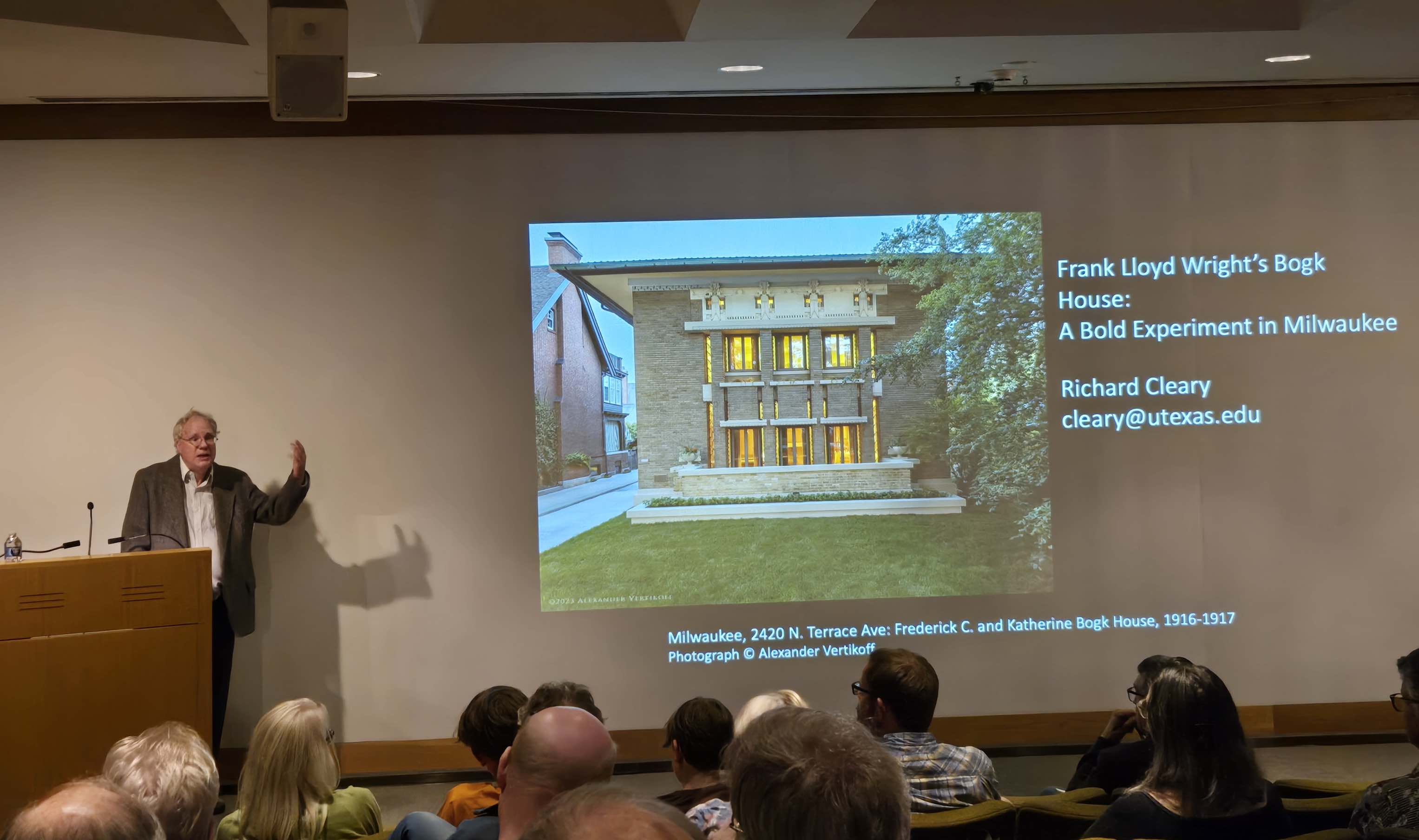
On the evening of Wednesday, April 22nd, the lecture hall at the Conrad A. Elvehjem Building was buzzing with a specific kind of energy—the kind that only happens when history buffs, architects, and Frank Lloyd Wright enthusiasts gather to reconsider a masterpiece they thought they already knew.
Professor Emeritus Richard L. Cleary took the stage to present "Frank Lloyd Wright’s Bogk House: A Bold Experiment in Milwaukee," providing a masterclass on a structure that remains one of the most intriguing, yet often misunderstood, anchors of Wright’s Wisconsin legacy.
A Master in Transition
Professor Cleary, co-author of the recently published Frank Lloyd Wright’s Bogk House: A Bold Experiment, opened by situating the audience in 1916. This was a "perplexing" phase for Wright. He was moving away from the quintessential Prairie School themes he had perfected in the previous decade and was searching for something more monumental.
Cleary’s lecture illuminated how the Bogk House served as a crucial laboratory for Wright’s evolution. While the house maintains some horizontal elements, it introduces a heavy, masonry-focused aesthetic that looks forward to his later "textile block" houses in California and his work on the Imperial Hotel in Tokyo.
The Power of the "Yes": The Bogk Family Legacy
One of the most compelling segments of the night focused on the clients themselves: Frederick C. and Katherine G. Bogk. Cleary shared fresh archival research that painted a picture of a couple willing to defy social gravity.
As second-generation German Americans who had achieved wealth and status in Milwaukee, the Bogks could have easily commissioned a traditional European-style mansion to signal their success. Instead, they gave Wright a platform for experimentation. Cleary argued that the house is as much a testament to the Bogks' forward-thinking nature as it is to Wright’s genius. Their commission allowed Wright to delve into ornamentation inspired by non-Western sources, creating a dialogue between the Milwaukee landscape and global architectural motifs.
New Findings and Visual Treasures
The highlights of the presentation were undoubtedly the unpublished drawings and rare archival photos Cleary shared. These visuals offered a rare glimpse into:
- The Geometry of Ornament: Detailed looks at the concrete cast ornament that wraps the house, showing its departure from the organic, "leaf and vine" patterns of Wright's earlier work.
- Spatial Complexity: Insights into how the interior manages to feel both protective and expansive, a hallmark of Wright’s transition toward more monolithic structures.
- Global Networks: How Wright’s mental map in 1916 wasn't just limited to the Midwest, but was actively drawing from his travels and professional networks across the globe.
A Night of Community Discovery
Following the lecture, a spirited Q&A session touched on everything from the technical challenges of preserving 100-year-old concrete to the house’s standing in the current Milwaukee architectural landscape. It was a reminder that the Bogk House isn't just a museum piece—it’s a living part of our community that continues to challenge and inspire.
We would like to extend a heartfelt thank you to Professor Cleary for his incredible scholarship, and to our sponsors at the UW–Madison Department of Art History, the Nancy M. Bruce Center for Design and Material Culture, and the University Lectures Committee for making this evening possible.
Deepen Your Knowledge:
If you weren't able to join us or want to revisit Cleary’s findings, we highly recommend picking up a copy of Frank Lloyd Wright’s Bogk House: A Bold Experiment. It’s a must-read for anyone looking to understand the "missing link" in Wright’s architectural journey.